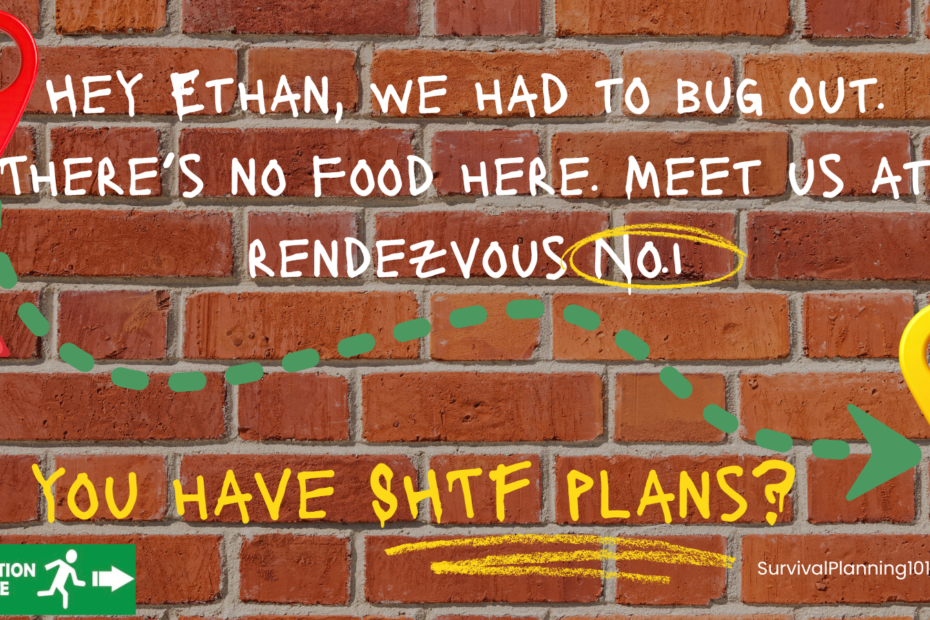
When disaster strikes, chaos spreads fast. However, the real danger is not always the event itself. It is separation. Families get split. Teams lose contact. Communication fails.
That is where SHTF (Shit Hits The Fan) plans become critical. These plans ensure that even if your tribe is scattered, everyone knows exactly where to go. Without a plan, people guess. With a plan, people move with purpose. That difference saves lives.
Why Simple SHTF Plans Work
SHTF plans are powerful strategies for worst-case scenarios. They focus on regrouping and movement when systems break down. Instead of relying on phones, these plans use:
- Pre-set meeting points
- Hardened decision rules
- Low-tech communication
Preparedness removes hesitation. When people know the next step, they act faster.
The Three-Tier Rendezvous System
Every effective survival plan uses a tiered system. However, in a lawless society, your locations must be discreet.
1. Primary Rendezvous (The Immediate Gap)
This is your first meeting location. It should be close but offer some concealment.
- Bad: A local park entrance or a statue.
- Good: A specific corner of a backyard or a nondescript alleyway near home.
2. Secondary Rendezvous (The Neighborhood Exit)
If your home or primary point is compromised, move here. This should be outside your immediate block. Choose a location that doesn’t look like a “target,” such as a derelict building or a specific wooded thicket.
3. Tertiary Rendezvous (The Bug-Out Location)
This is your long-term fallback. It is where your group regroups if the city becomes untenable. This is usually a rural property or a pre-stocked wilderness camp. Every member must memorize these spots. Never write the exact addresses on your map.
Map Your Routes for Total Anarchy
Knowing where to go is only half the battle. You must also know how to get there safely. High-stress navigation requires three paths:
- Primary Route: The fastest way.
- Alternate Route: Side streets and alleys.
- Last-Resort Path: A route through parks, tracks, or waterways.
Avoid highways. They clog and become “kill zones” or checkpoints. Use a physical map, but use a personal code for your marks. If someone steals your map, they should not be able to find your family.
Communicate When Networks Die
Communication is the first system to collapse. Your plan must work in total silence.
- Dead Drops: Leave a “sign of life” at a rendezvous point, like a specific colored ribbon or a chalk mark.
- Set Windows: Only check rendezvous points at specific times (e.g., every 4 hours on the hour) to avoid loitering in the open.
- Radio Silence: Use walkie-talkies for listening only. Transmitting can give away your position to those with scanners.
Use “If-Then” Rules to Kill Panic
Clear decisions reduce fear. Use “if-then” logic to automate your survival:
- If the primary point is blocked, then proceed immediately to the secondary.
- If no one arrives at the secondary within 6 hours, then move to the tertiary.
The Stealth Go-Kit: Carry to Survive
Each person must move independently. In a lawless society, avoid “tactical” looking bags. Use an old school backpack to blend in.
- Essentials: Water, high-calorie bars, and a flashlight.
- Defense: Basic first aid and a means of protection.
- Navigation: A compass and your coded map.
Practice: The Only Way to Find Weakness
Planning is not enough. You must test your strategy. Run a “Blackout Drill” where you turn off all phones and try to meet at your secondary location. You will find flaws quickly. Fix them now, while the world is still quiet.
Final Thoughts: Your Plan Is Your Lifeline
Gear is helpful, but a disciplined plan saves lives. Strong SHTF plans provide direction in chaos. They turn fear into action and bring your people back together. Do not wait for a disaster to choose your path.
In a high-threat environment, safety comes from anonymity and cover. Avoid landmarks like “the clock tower” or “the main gate of the park,” as these are natural magnets for crowds and potential threats. Instead, choose a nondescript location that offers multiple exit points and visual concealment, such as a specific thicket of trees in a large woods or a side door of an abandoned, unremarkable warehouse. The goal is to see your group members before they (or anyone else) see you.
Your SHTF plans should include a pre-set “Window of Arrival.” In a lawless society, loitering in one spot makes you a target. Establish a rule, such as: “Arrive at the rendezvous at the top of every even-numbered hour and wait for exactly 15 minutes.” If no one arrives within that window, hide nearby or move to the next tiered location. This “If-Then” rule ensures you aren’t sitting ducks while waiting for separated members.
How to Build a Stealth SHTF Plan in 5 Steps
In a lawless society, the goal is to regroup without drawing attention. Follow these steps to create a resilient, low-profile plan for your group.
- Identify Three Discreet Tiers
Select three meeting points: Primary (near home), Secondary (outside the neighborhood), and Tertiary (outside the city). Avoid public landmarks like statues or main gates; choose “invisible” spots like a specific alleyway or a nondescript thicket of trees that offer concealment.
- Map “Ghost” Routes
Identify three paths to each location: a fast primary route, a side-street alternate, and a “last resort” walkable path through tracks or parks. Avoid main highways, as these become bottlenecks or checkpoints. Memorize these routes so you aren’t reliant on a map that could be stolen.
- Set “Time Window” Rules
Do not loiter at meeting points. Establish a rule to check the rendezvous at specific times—for example, at the top of every even-numbered hour (2:00, 4:00, etc.) for exactly 15 minutes. If no one arrives, move to cover or proceed to the next tier to avoid becoming a stationary target.
- Establish Low-Tech Signals
Create a “Dead Drop” system to leave messages without staying on-site. Agree on a subtle sign, such as a specific colored pebble on a certain brick or a chalk mark on a fence, to indicate “I was here and moved to Rendezvous #2.” This allows for communication without radio or cellular signals.
- Conduct a “Blackout” Rehearsal
A plan is just a theory until it’s tested. Pick a weekend to turn off all phones and GPS. Attempt to meet your group at the Secondary Rendezvous using only your memorized routes and “Time Window” rules. Identify where you hesitated or felt exposed, and adjust your plan accordingly.